Project details
Okoa Mlo is derived from the Swahili language. It is made up of two words. “Okoa” which means save and “Mlo” which means food. This basically adds up to bring out the phrase, “Save food”. The Okoa Mlo project involves the designing and developing of a custom and mobile friendly website and application that will be used to ultimately help in the attainment of the UN Secretary-General’s Zero Hunger Challenge by implementing one of its major elements which is zero loss or waste of food. The user-friendly set of tools that may also involve a USSD code will be available to fulfill a simple objective. This is, linking one who has excess food and one who needs it like, children homes, street families and the poor. Distribution will be done by the organizations such as UNEP and Red Cross.
How will the application work?
Restaurants, households and even individuals involve themselves with the preparation and consumption of food. These are places where several tonnes of food are wasted daily with post-harvest losses running up to 15 to 20 percent of the total cereals production and even higher for perishable products due to poor storage and other inefficient farm infrastructure. The excess food is normally disposed of at most times thus leading to wastage of food.
So, how does this mobile application help with excess food or produce? Why is a mobile application being associated with disposing of excess food and not the supply of fast food to food junkies?
To answer this questions then,
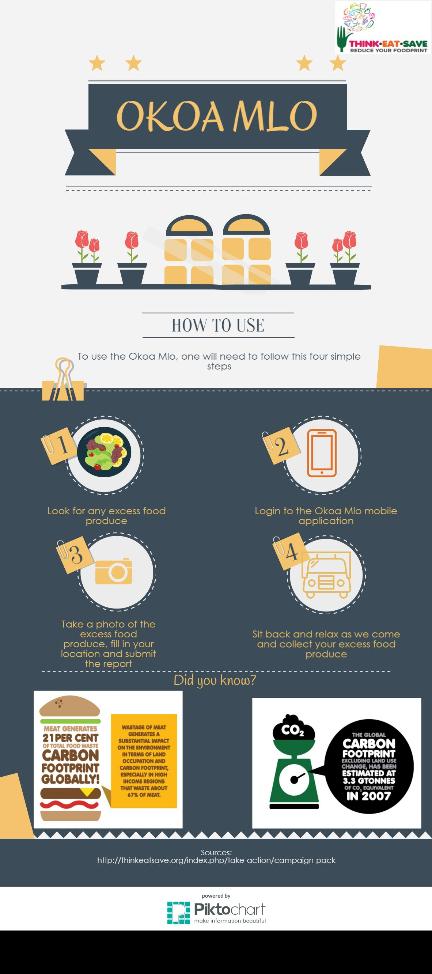
Some individuals if not all, wish they would make this excess food and produce available to the other individuals who are in need of this food, but this is not the case for people who do not even know where they would take this food. This is where this mobile application comes in. It will have the capability of allowing users to create and manage profiles. The users being targeted include restaurants, households, farm-owners etc. On obtaining this application, any user with excess food and is willing to donate the excess food produce, will be linked with those that need this food produce through agencies such as UNEP and Red Cross, instead of disposing the excess food and leading to food wastage.
Hypothetically,
Mr. X is a farm owner. During the harvest season, he reaps enough produce. He will then sell his produce to his frequent customers and consume with his family part of the produce. Later on, due to poor storage methods, he will dispose of any excess thus incurring losses because of this disposal of excess produce. With this application, he will be able to login to his profile. If he does not have the benefit of a smartphone, he will use an USSD (Unstructured Supplementary Service Data) code. He will then provide information on his excess food produce and possibly upload a photo to cater for the planning of the mode of collection of this food produce. Once this is done, the excess produce will be collected using out-sourced means of transport and delivered to a central place for distribution to agencies such as UNEP and The Red Cross Society. It will then be distributed to subsequent children homes and groups that are in need of this farm produce. Thus, reducing food wastage.
While promoting this application, we intend to attain the specific objectives:
v Minimizing food losses during storage and transport, and waste of food by retailers and consumers
v Commitments by producers, retailers and consumers within various geographical areas
v Achieving progress through financial incentives i.e. discounted prices for the excess food being sold
v Changed behavior
We hope to help in the attainment of the UN Secretary General’s Zero Hunger Challenge. The major contributors to the carbon footprint of food wastage are cereals followed by meat and vegetables. With reference to cereals like maize, we can effectively reduce the carbon footprint by donating this instead of throwing it way leading to food wastage.
Let’s promote Okoa Mlo to reduce our food print and have a better world.
References:
UN. (2012). Zero Hunger Challenge. Retrieved from United Nations: http://www.un.org/en/zerohunger/challenge.shtml